Advent
Jesse Tree
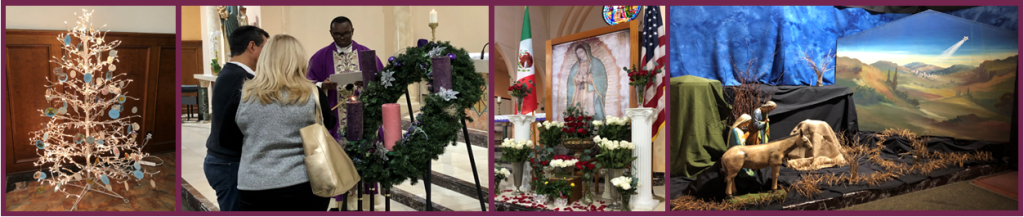
Every Advent, St. John's has a Jesse Tree in the vestibule decorated with ornament tags representing wish list items for the Aseltine School and Restoring Citizens.
We collect all donated wish list items and then deliver them right after Christmas.
Since 1968, Aseltine School has served at-risk youth with severe emotional disturbances and learning disabilities, whose needs cannot be met in the public schools.
Restoring Citizens was founded in 2017 by an individual with lived experience in prison and gang lifestyles and was created to address the unmet need for reentry services in San Diego.
If you’d like to learn more about the Aseltine School and the Restoring Citizens, go to their websites, respectively: https://aseltine.org/ and
https://rrasd.org/listing/restoring-citizens-normal-st/;
https://www.restoringcitizens.org/
Advent Wreath
Advent wreaths traditionally hold four candles (three are purple and one is pink). The candles represent Jesus coming as a light in the darkness. One candle is lit each Sunday until all four candles are lit. Each of the candles lit before Christmas represent an aspect of preparation during the season of Advent. The week one candle is purple and represents the hope in Jesus’ coming. The week two candle is also purple and represents peace and preparation for the coming of Jesus. The week three candle is pink and represents the joy in the upcoming arrival of Jesus. This Sunday is often called "Gaudete Sunday". The final candle is purple and represents love.
Our Lady of Guadalupe
Here at St. John’s we celebrate Our Lady of Guadalupe by…
The feast of Our Lady of Guadalupe commemorates the Virgin Mary appearing to a peasant in 1531. This Catholic holiday, on Dec. 12, honors Mary, Mexico's patron saint who is also referred as the Lady of the Americas. It's a special day for Mexican Americans, too, because of their cultural and religious identity in this icon of Catholicism.
Simbang Gabi
Here at St. John’s we celebrate Simbang Gabi by…
Simbang Gabi is a Filipino spiritual tradition of Mass on each of the nine days before Christmas.
In the Philippines, Simbang Gabi novena Masses were celebrated at dawn, when the roosters crow, hence the name Misa de Gallo or “Mass of the Rooster.” This was done for very practical reasons - Filipinos then were farmers or fishers who either began or ended their day at dawn.
The tradition of Simbang Gabi continues in the United States, but it has been altered a bit from its original form. Most novena Masses are held indoors in the evening, not at the crack of dawn. In addition, not all parishes celebrate the full nine days. Sometimes neighboring parishes each take one of the nine nights, and people go from church to church for the novena.
Many parishes have families process in with the traditional star lanterns fashioned of bamboo and paper, symbolizing that we are preparing our hearts and homes to welcome and receive Christ, our Light. These parols can also be seen in any Filipino home during the Advent season. There is usually a Filipino cloth to cover the altar, an offering of the Filipino national flower, sambaguita, which is like sweet jasmine, as well as a basket of fruit at the presentation of the gifts. No Filipino liturgical celebration is complete without a reception. If there are no sweet rice cakes or puto bumbong or ginger tea, there will at least be sandwiches, sweet bread, and maybe even pancit (noodles mixed with vegetables and meat) and lumpia (egg rolls).